Designer of
Indian National Flag
Sri Pingali Venkaiah
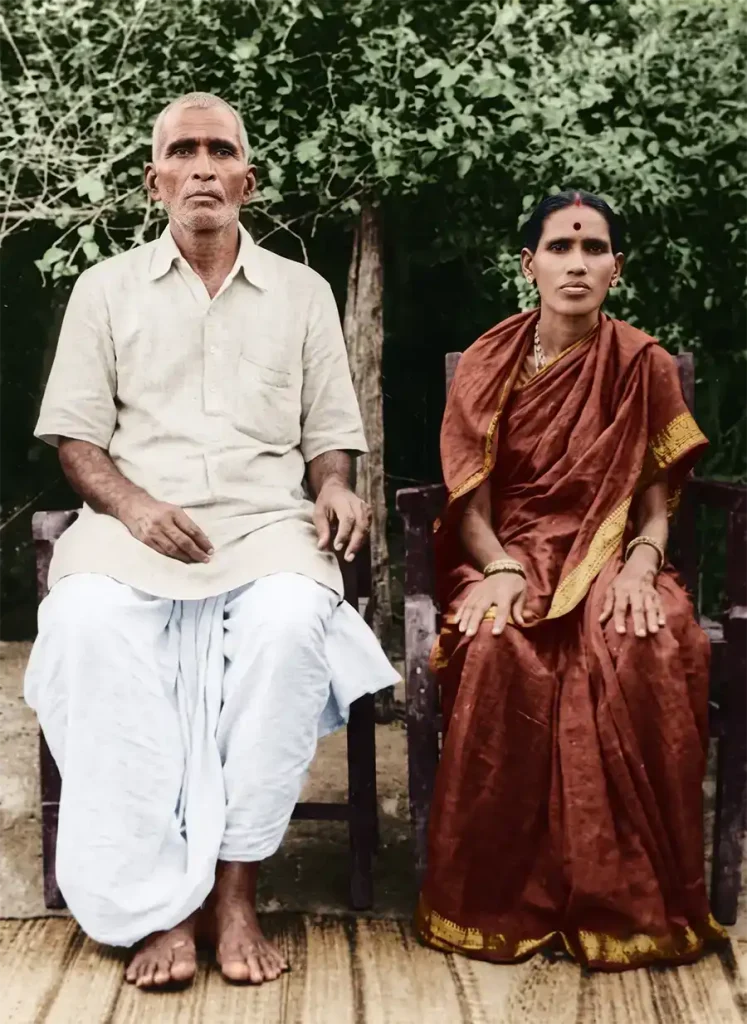
Sri Pingali Venkaiah garu and his wife, Smt. Rukminamma garu
About Sri Pingali Venkaiah Garu
Sri Pingali Venkaiah Garu (1876–1963) occupies a place of lasting honour in the history of India as a freedom fighter, educationist, scholar and the visionary whose flag design formed a crucial stage in the evolution of the Indian National Flag. Born on 2 August 1876 at Bhatlapenumarru, near Machilipatnam in present-day Andhra Pradesh, he belonged to a generation of patriots who recognised that a nation aspiring for freedom also needed a unifying symbol capable of awakening pride, sacrifice and collective purpose.
Official Government of India accounts remember him as a freedom fighter and as the designer associated with the National Flag that evokes pride and patriotism in millions of Indians.
Sri Pingali Venkaiah Garu was a man of wide learning and uncommon intellectual curiosity. His interests extended beyond the freedom movement to agriculture, education, geology and languages. His research into cotton varieties earned him the affectionate name “Patti Venkaiah”, while his knowledge of Japanese led to his being remembered as “Japan Venkaiah”. His interest in geology and minerals also came to be associated with the name “Diamond Venkaiah”. These popular descriptions reveal the extraordinary range of his pursuits and the spirit of inquiry that characterised his life.
His enduring national contribution grew out of his sustained study of flags and his conviction that India needed a flag of its own. In 1916, he published a booklet titled “A National Flag for India” describing the flags of different countries and setting out ideas for an Indian national flag. He continued to study and advocate possible designs during the freedom movement.
The defining moment came in 1921, at the Congress session held at Bezwada, now Vijayawada, where Sri Pingali Venkaiah Garu presented a flag design to Mahatma Gandhi. The design included stripes representing the communities of India living in harmony, with a spinning wheel at the centre signifying progress and self-reliance. It became an important foundation in the subsequent development of the national flag. In 1931, the Indian National Congress formally adopted a modified form of the flag with saffron, white and green. Finally, on 22 July 1947, the Constituent Assembly adopted the National Flag of free India, retaining the Tricolour and replacing the spinning wheel with the Ashoka Chakra.
Sri Pingali Venkaiah Garu’s contribution was therefore far greater than the creation of a design. He helped give visible expression to the aspirations of a nation seeking freedom and unity. The Tricolour that India reveres today embodies courage, peace, truth, growth and the shared destiny of its people, and his name remains inseparably connected with its historic evolution.
Despite the magnitude of his contribution, Sri Pingali Venkaiah Garu lived a life of simplicity and did not receive recognition proportionate to his national service during his lifetime. He passed away on 4 July 1963. In later decades, sustained efforts were made to restore his rightful place in public memory. A significant milestone was reached on 12 August 2009, when the Department of Posts issued a Rs.5 commemorative postage stamp in his honour. The stamp was formally released at Hyderabad by the then Chief Minister of Andhra Pradesh, Dr. Y. S. Rajasekhara Reddy, in the presence of representatives of the Sri Pingali Venkaiah Charitable Trust and members of Sri Pingali Venkaiah Garu’s family, including Smt. Pingali Suseela, a member of his family and a Trustee of the Trust. The occasion held special significance for the Trust, whose Founder-President, Late Smt. K.H.S. Jagadamba Garu, had pursued the cause of securing due recognition for him with sustained dedication, and whose efforts were acknowledged at the event. In 2022, the Government of India further honoured his legacy through the Tiranga Utsav held in New Delhi on his birth anniversary, where members of Sri Pingali Venkaiah Garu’s family, including Smt. Pingali Suseela, were honoured by the Union Home Minister, Shri Amit Shah.
Sri Pingali Venkaiah Garu remains an enduring symbol of intellectual excellence, patriotic devotion and selfless national service. His life reminds every generation that a single idea, pursued with conviction and offered without expectation of personal reward, can become part of the permanent identity of a nation. As the Tricolour flies across India and throughout the world, it carries with it the memory of the visionary patriot whose efforts helped give the country its most cherished national emblem.